|

SINGLE ANIMALS
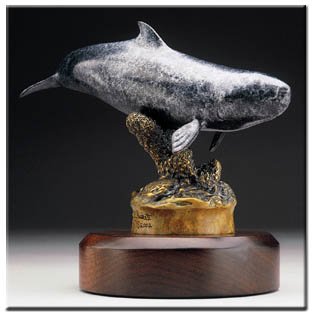 |
| Title: Ami (Pygmy Sperm Whale) | ||
| Year Released: 2002 | Edition: 350 | Price: $1,650.00 |
| Dimensions: 6 1/2"H 8 1/2"W 4 3/4"D | ||
|
On January 20, 2001, a pygmy sperm whale (Kogia breviceps) and her newborn calf were found stranded at North Miami Beach, Florida. They were picked up and taken to the Dolphin and Whale Hospital at Mote Marine Laboratory in Sarasota, Florida. The mother whale was suffering from an unknown virus, and she died within four days, leaving her orphaned calf. Before the mother died however, the staff at Mote were able to obtain samples of her milk and analyze it. This allowed the preparation of a formula for the newborn calf they named Ami. Pygmy sperm whales are relatively uncommon deep-water animals. Very little is known about them. They reach about eleven feet in length, and about 800 Ib. full grown. Until Ami, no pygmy sperm whale had ever been kept alive by people for more than six months, with most lasting only a few days or weeks. I met Ami as the folks at Mote were celebrating her first birthday in January, 2002. I think that just about everyone who met Ami fell in love with her. I know I did. She was like a huge, gentle, curious Golden Retriever puppy with flippers instead of legs. She'd race around the pool and breach and play, but always seemed to know exactly where you were, and was careful not to land on you or run into you. She'd come up to her surrogate "moms," the volunteers who spent a lot of time in the water with her, and nuzzle like a puppy, opening her mouth so they could scratch her tongue. Ami died October 12, 2002, of an intestinal disorder, having lived almost two years at Mote, more than three times longer than any pygmy sperm whale previously cared for by people anywhere. Her death is a terribly sad thing to anyone who had met her, however, her stay at Mote tremendously enlarged our knowledge of these rare little whales and her personality captured everyone's heart. That Ami lived at all is completely due to the dedication, skill, and pure hard work of the staff and volunteers at Mote Marine Laboratory. Rescuing and caring for stranded marine animals is a 24/7 operation. For months Ami needed continuous care. Volunteers and staff assisted her in the water 24 hours a day, every day, with medical tests, blood work, antibiotics, vitamins, and the proper food. In the case of a very young animal such as Ami, an infant formula must not only be developed from scratch, but "bottle fed" to the baby on a 'round the clock feeding schedule, just like an infant human. This involves training a very young (but at the same time pretty big) animal to allow itself to have a tube passed through its mouth, down its throat, and into its stomach! Several times each day and night! Imagine a rainy, windy night, three o'clock in the morning, five months after Ami was rescued. All the "new" has worn off with the public and the media. Still, people are hearing their alarm clocks go off at home, climbing out of bed, coming down to Mote to put on wet suits and climb into the water with this odd little whale to help feed her and just keep her company! These folks aren't being paid a nickle for this! They are doing it day in and day out, on burning hot days and cold rainy nights, around the clock and around the calendar. These are some of Mote's volunteers. AMI is dedicated to these incredible volunteers and staff at Mote Marine Laboratory, and to all those folks around the world who have spent their time and labor and skill caring for orphans like Ami, and doing all the thousand and one things that volunteers at aquaria, zoos, museums, and all such institutions do every day. |
||
|
|
||
View Enlargement |
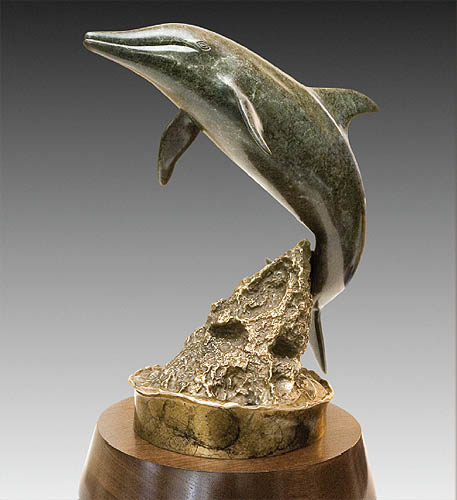
| Title: Blitzen (Rough toothed dolphin) | ||
| Year Released: 2005 | Edition: 350 | Price: $2,400.00 |
| Dimensions: 12" H 8 1/2" W 8"D | ||
|
Stenos, or rough toothed dolphins, are found in all the world's oceans, between latitudes 40°N. and 35°S. With their smooth conical heads, large paddle shaped flippers and large eyes, they look more like ichthyosaurs (marine reptiles from the age of dinosaurs) than like any other dolphin species. Usually covered with scars from squid, other stenos, and the round pink scars caused by cookie cutter sharks, stenos seem to live a very rough and tumble life. The first steno ever kept in captivity was captured by Sea Life Park in Hawaii in 1965, and studied by Karen Pryor and the late Dr. Ken Norris (advisor, long time colleague, and close friend of Dr. Randy Wells at Mote Marine Laboratory). Among those who have worked with stenos, these dolphins have a reputation for being extremely intelligent and imbued with a much stronger sense of "self' than other dolphin species. There's a story I've heard of a dolphin trainer working with a steno. The trainer would send the dolphin out to do a certain task and when the task was completed, reward it with a fish. Standard training procedure. Only, each time the steno came back, it would stop an inch or two farther from the edge of the pool, causing the trainer to have to stretch farther to give it the fish. When the trainer was stretched out so far that she was teetering, ready to fall in, she finally realized that the steno was training the trainer! Dolphins really do have a sense of humor! Blitzen is named in honor of a steno rescued and treated by Mote Marine Laboratory in Sarasota, Florida during the Christmas season of 1997 and successfully released back into the wild in March of 1998. |
||
|
|
||
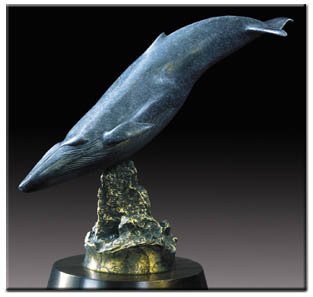 |
| Title: Blue Diver | ||
| Year Released: 2003 | Edition: 350 | Price: $1,975.00 |
| Dimensions: 9 1/2"H 9 3/4"W 5 1/4"D | ||
|
Blue Whales are probably the largest animal ever to live on earth, certainly the largest currently living. When Blue Whales dive, they often throw their tail flukes clear of the water on the way down. In places like the Gulf of California, where Blue Whales and Fin Whales are often found close to each other, this "fluking out" can be used as an identifying characteristic, as Fins almost never show their flukes. If you draw an imaginary line across BLUE DIVER just above the dorsal fin, and pretend it is the water surface, what lies above the line is what you see when a Blue Whale dives. The flukes of a diving Blue Whale are among the most elegant forms found in nature. |
||
|
|
||
View Enlargement |
View Enlargement |
| Title: The Breach | ||
| Year Released: 2007 | Edition: 350 | Price: $2,650.00 |
| Dimensions: 13 1/2" H 8" W 7" D | ||
|
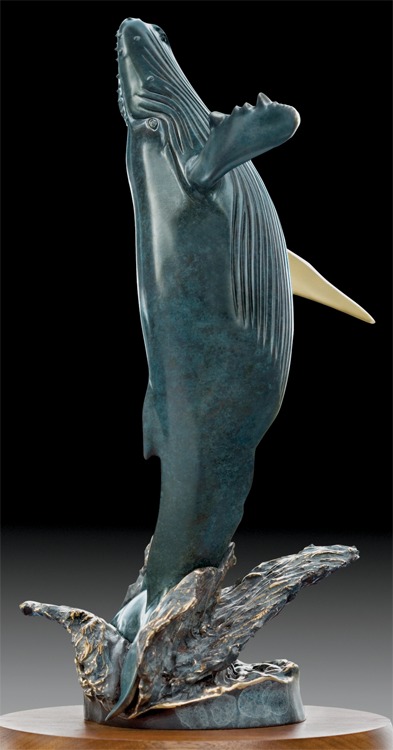
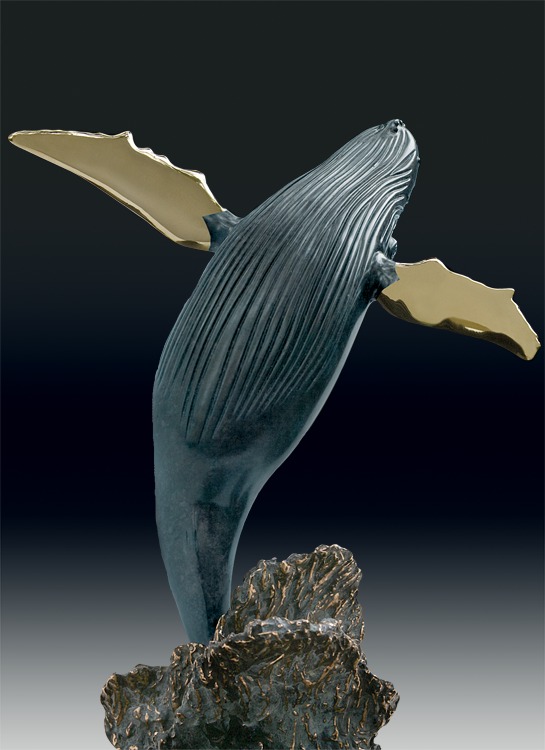
From the sheltered waters between Maui and Lanai to Gorda Banks off the tip of Baja and from Tonga in the South Pacific to the Arabian Sea, wherever humpback whales congregate, if you're lucky, you can watch them breach. Nowhere in nature is there a sight more powerful, more spectacular, than that of a forty-ton humpback whale hurling itself straight up, sometimes clearing the water entirely. THE BREACH is my interpretation of this act, and is dedicated to those scientists who spend their lives studying them and learning how they live and how better to preserve them and their environment. |
||
|
|
||
 |
| Title: Inland | ||
| Year Released: 2003 | Edition: 350 | Price: $2,450.00 |
| Dimensions: 10"H 10 1/2"W 7 1/2"D | ||
|
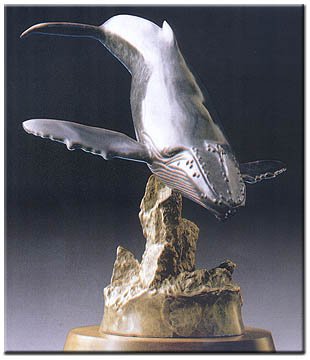
In the fall of 2000, a young female humpback whale took up temporary residence inside Boston, Salem, and Gloucester harbors in Massachusetts. From September through December this youngster, about 28 feet long, cruised and rested and played and fed, often within 100 feet of shore. Local newspapers and television stations regularly featured her and hundreds of people would come out every day to see her from the shore. For many of these folks, this was their first "in person" experience with a whale. Because of her habit of staying so close to shore, and because the markings on the underside of her tail flukes looked sort of like an "I" and an "L", she was named INLAND. The following spring, in April, 2001, INLAND was found tangled in gill net off Virginia Beach, Virginia, dead. Otherwise healthy, according to a necropsy, INLAND died as a result of her entanglement. While the death of one whale, even though caused by human activity, is not a world shattering tragedy, it is sad that an animal that gave so much delight to so many people should die this way. To have some good come out of this, her skeleton was recovered by the Whale Center of New England, and will serve as the centerpiece for an educational display about the biology of humpback whales at the New England Whale Center in Gloucester, MA. I've created this sculpture of INLAND to commemorate her, and the scientists and volunteers who work so hard to study and understand and protect these incredible creatures. |
||
|
|
||
 |
| Title: Orca | ||
| Year Released: 1985 | Edition: 250 | Price: $2,450.00 |
| Dimensions: 9"H 10"W 5"D | ||
|
|
||
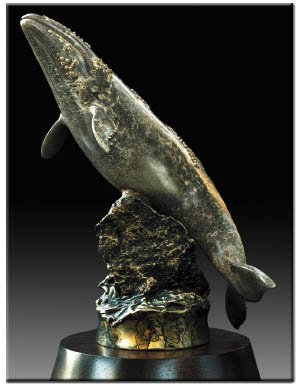 |
| Title: Sneak Peek | ||
| Year Released: 2003 | Edition: 350 | Price: $1,975.00 |
| Dimensions: 9 1/2"H 6"W 5 1/4"D | ||
|
One of the enchanting things done by Gray whales is called "Spyhopping". The Whale will lift its head above the water vertically, or nearly vertical, up to about the level of its eyes, and hold that position. This can sometimes last several minutes. Though no one knows for sure exactly why they do this, it looks as if they are looking around above the water - sort of a "sneak peek" at the world of air that their ancestors left millennia ago. If you draw an imaginary line across this piece just at eye level, and pretend it is the surface of the water, what is above this line is what you see when they spyhop. |
||
|
|
||
View Enlargement |
View Enlargement |
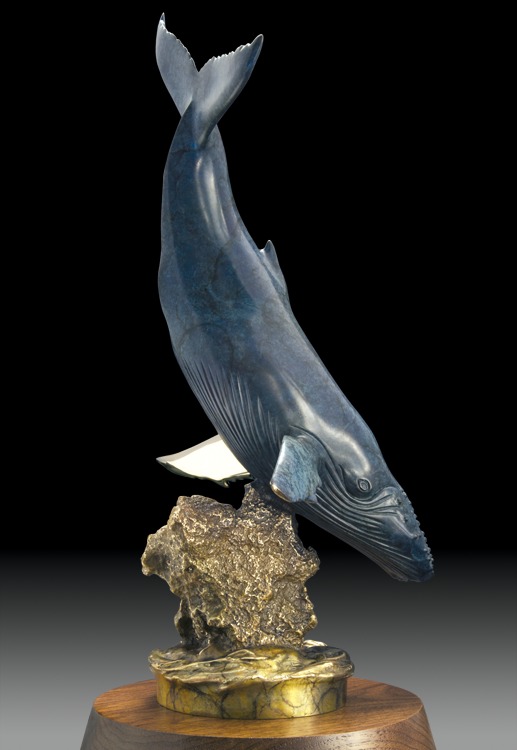
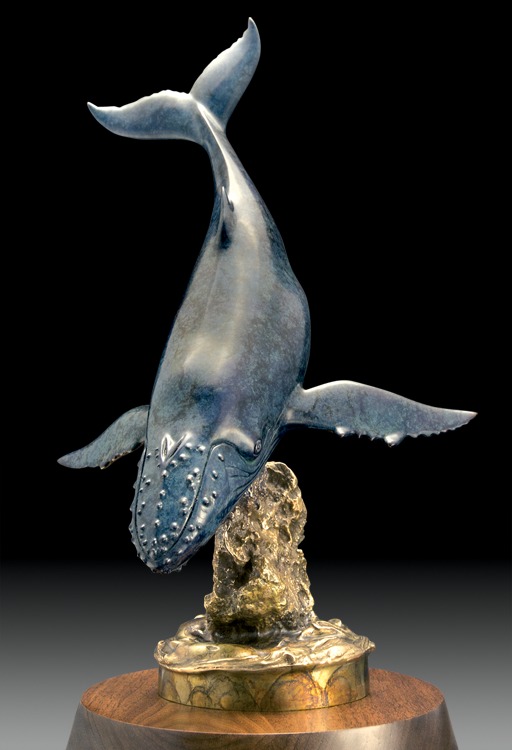
| Title: The Song | ||
| Year Released: 2008 | Edition: 350 | Price: $2,650.00 |
| Dimensions: 14" H 8 1/2" W 7 1/2" D | ||
|
Humpback Whales sing. It is one of the most fascinating things about these animals. Scientists have been recording and studying whale songs since the late 1960's. They have discovered many things about the songs, such as, only males sing, all the males in a given area (for instance, the North Pacific Ocean) sing the same song each year, and from year to year the song changes. THE SONG portrays a male humpback in the head down position most often observed while "singing." This acoustic behavior of the humpback whale, among the most haunting, unforgettable sounds in nature, remains one of nature's great riddles after fifty years of study. Though we don't know the reasons for the songs, humpback communities continue their alluring "social" behavior and we delight in the mystery of it. |
||
|
|
||
View Enlargement |
View Enlargement |
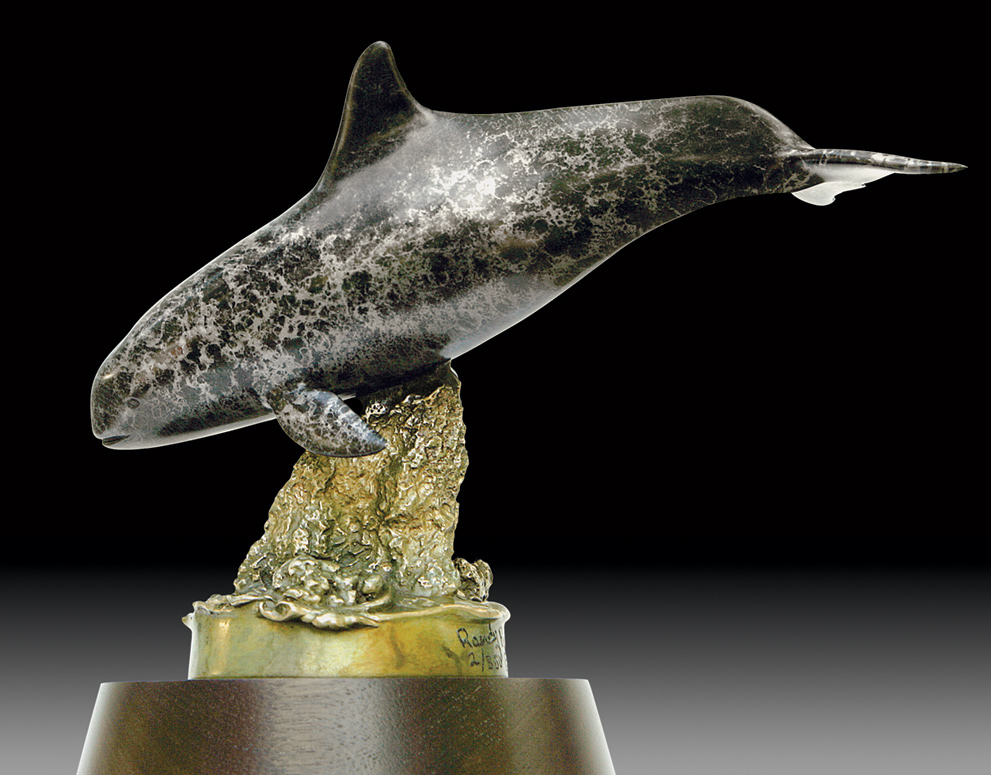
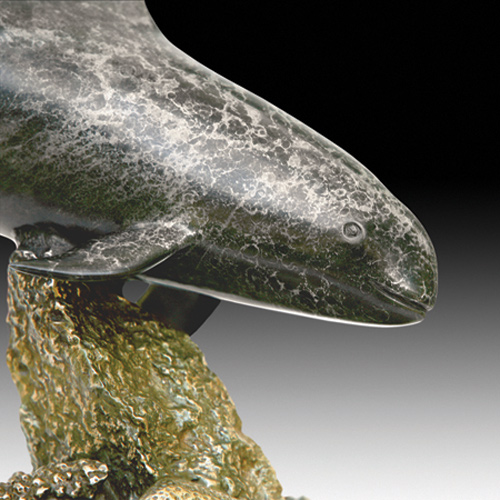
| Title: Vaquita - (Closed Edition) | ||
| Year Released: 2009 | Edition: 350 | Market Price: $2,000.00 |
| Dimensions: 8.5"H 10"W 6"D | ||
|
The vaquita is the rarest and most endangered cetacean on earth, probably numbering less than 150 animals. It is a small porpoise, measuring less than five feet long, found only in a tiny region off the mouth of the Coloradoo River, and the very north end of the Gulf of California. Their entire range is one-fourth the size of the city of Los Angeles, and is located less than four hours southeast of San Diego. Vaquitas are shy and elusive, and very little is known about them. They were only described and recognized as a separate species in 1958. Vaquitas have never been photographed underwater, and are known mostly from individuals trapped and drowned in fish and shrimp nets. With this sculpture, VAQUITA, I hope to draw attention to this small, beautiful animal. Human activity, gill netting for fish and shrimp, has driven them to the very edge of extinction. Only human effort, our effort, can bring them back. |
||
|
|
||
Home | Gallery | The Artist | Conservation | Contact Us | News | Order Info
 |
|||||||||||
 |
|
 |
|||||||||
 |
|||||||||||